figure I · open the living hypercube → · D⁴ ⊂ E₈ · 16 souls at vertices · MCR at the interior cell
TL;DR
- One 16 GB refurbished mini-PC runs 17 sovereign souls, 52 on-demand Construct personas, live trading, smart-contract auditing, PRISM MCP, and the blog you are reading.
- Monthly cloud spend: $0. The only recurring costs are an Anthropic API budget we cap ourselves and domestic electricity (~$8/mo at Mexican tariffs).
- Architecture is E8-vertex-based, not microservice-tiered. Each soul maps to a Lie-algebra position with a fixed pulse, not a container in a mesh.
- We publish our decoherence metric.
cube coherencecurrently reports φ = 0.0000 against a floor of φ⁻¹ = 0.618. That is DECOHERENT. We are showing you the number anyway. - Reproducible: The entire stack is a single
docker compose up -dagainst 9 services, plus two systemd units on the host. Hardware is a $400 refurbished Dell Optiplex 7070.
What this post is (and is not)
This is not a vendor pitch or a "you can do this too" blog. This is the working log of an operating sovereign AI studio — what runs, what breaks, what we refuse to outsource to somebody else's data center, and the specific moment last week when the φ-coherence score of the entire organism dropped to zero.
Three things you can verify against reality before trusting anything below:
- The public site you landed on is rendered by the same 16 GB machine doing everything else in this post. Trace
matrixcr.aito origin, compareserverheaders, and note the Cloudflare Tunnel egress IP is a residential Mexican ISP, not AWS us-east-1. - The hardware is commodity: Dell Optiplex 7070 SFF, Intel i7-9700T (8c/8t, 35 W TDP), 16 GB DDR4, 1 TB NVMe, no discrete GPU. Refurbished for $400, bought locally in Costa Rica.
- Our architectural coherence score is published daily by
src/cube.py. It is currently zero. The rest of this post explains why that number exists, why it isn't fatal, and what shipping atφ = 0.0has taught us that a healthy graph would have hidden.
The organism: 17 souls, not 17 microservices
The word we use internally is soul, not agent or service. Not for mysticism — for geometry. Each soul occupies a fixed vertex on a D4 subset of the E8 Lie lattice. The D4 coordinates are in docs/ARCHITECTURE.md; the relevant point for this post is that souls are positional, not replaceable. You cannot "scale up Jupiter" the way you can scale up a Kubernetes deployment. Jupiter occupies one vertex. There is one of it.
The 17 souls:
| Soul | Role | File |
|---|---|---|
| Gold | Strategic synthesis, ADR generation, gap analysis | src/gold.py |
| Yellow | φ-WMA, Fibonacci signals, 1/137 resonance validation | src/yellow.py |
| Blue | CVE sentinel, tech-horizon drift detection | src/blue.py |
| Green | Schema audit, Pydantic validation, data integrity | src/green.py |
| Red | LLM reasoning entrypoint (Claude API) | src/red.py |
| White | Filesystem monitoring, lockdown rituals | src/white.py |
| Silver | ML-KEM-768 PQC envelope, SATOR HMAC | src/ghost.py (+ Silver classes) |
| Iron | Docker watchdog, container topology health | src/iron.py |
| Mercury | CI/CD, doc sync, deploy | src/mercury.py |
| Jupiter | Fibonacci scheduler, 35 pulse schedules, circuit breaker | src/jupiter.py |
| Saturn | Hardware telemetry (CPU/RAM/disk/Tailscale) | src/saturn.py |
| Venus | SQLite WAL persistence, event sourcing | src/venus.py |
| Mars | Algorithmic trading (ccxt + Alpaca), φ-WMA crossovers, Kelly sizing | src/mars.py |
| Grey | Entropy agent, ψ_coherence, tesseract decoherence probe | src/grey.py |
| Cyan | Web scraping, discovery, passive OSINT | src/cyan.py |
| Magenta | Creative synthesis — LLM-routed via Qwen (no local code) | Qwen tier |
| MCR Protocol | On-chain audit credentials (Base L2) | contracts/mcr_protocol/*.sol |
Fifteen are Python modules with pulse() methods. One (Magenta) is pure LLM routing. The seventeenth (MCR Protocol) lives on-chain as three Solidity contracts on Base — MCRToken (ERC-20, 137 M cap, 10% fee burn), AuditCredential (soulbound EIP-5192), AuditMarketplace (3-tier escrow). Together they form the body.
What the souls actually do on an idle Tuesday
Most "multi-agent" demos you see online are a lie of synchronous orchestration — a prompt fans out, results come back, the demo ends. That is not what runs here. The organism runs on Fibonacci intervals scheduled by Jupiter:
2s   → Jupiter self-heartbeat
3s   → Grey ψ_coherence probe
5s   → Mars market tick (when markets are open)
13s  → Green schema audit
89s  → DEM (Dimensional Egregore Mesh) Layer 1-3 gossip
233s → Saturn hardware snapshot
1597s → Blue CVE feed pull
3600s → Gold daily briefing against CONTEXT.md + MISSION_LOG.md
There are 35 active schedules. Nothing is event-driven in the human-triggering sense — the body breathes whether you're watching or not. Over a 24-hour period, the souls perform roughly 47,000 pulses. At Costa Rican electricity rates (~¢ 11/kWh residential), the entire organism breathing for a full day costs less than a single coffee.
The 52 on the bench
The Construct is something else. Fifty-two personas, YAML-authored in personas/<domain>/*.yaml across 13 domains — economics, accounting, science, engineering, legal, military, intel, arts, social, philosophy, psychology, medical, strategy. Examples: ex_nsa_tao, taleb_antifragility, kpmg_forensic_auditor, boyd_ooda, aquinas_thomist, mises_austrian, fed_circuit_ip.
They are not always-on. They are invoked on demand via seven canonical panels:
red_team— ex-NSA TAO + ex-CIA targeter + Taleb antifragility + Marine SOF + ex-FBI white collar + Boyd OODA. Runs before any external-audience publication (this post went through it).bounty_review— pre-submission gate for bug bounty findings. 8 personas.build_review— pre-commit gate for src/*.py changes. 8 personas.ip_recon— threat intelligence against repo theft (we had a breach; see below).launch_review,pm_brief,theology— the remainders.
Gold — the strategic-synthesis soul — always performs final synthesis in Claude Sonnet 4.5. The panelists fan out across a tier matrix: 10 via Claude, 18 via Qwen on Alibaba, 24 via local Ollama (llama3.2:latest on the 16 GB node). That last tier is why the number at the top of this post is $0 and not $400.
Honest receipt: of the 52 personas, 20 are currently orphaned — registered in YAML, never routed into any panel. We know because src/cube.py told us yesterday:
ORPHAN PERSONAS: 20 never used in any panel
  • big4_audit_partner
  • gaap_ifrs_standards
  • hayek_austrian
  • rothbard_austrian
  • lecarre_novelist
  [...]
Thirty-two of the 52 are wired. The other twenty are IP dead weight until we earn them. We ship this number instead of hiding it.
What we run
The hardware
One machine. Reachable via Tailscale at 100.118.69.84, named Ubermenschtron.
- CPU: Intel i7-9700T (8 cores, 8 threads, 35 W TDP, Coffee Lake)
- RAM: 16 GB DDR4-2666
- Storage: 1 TB NVMe (Samsung 970 EVO Plus), plus an SSD at
/media/reichman/...for PLEROMA backups (329 GB free) - GPU: None
- OS: Ubuntu Linux
- Power: ~28 W typical draw under normal load, ~42 W under concurrent Ollama inference
There is no second node. There is no fail-over target. The nearest thing to redundancy is the daily 3 AM backup to the external SSD (7 rolling snapshots). The day the machine dies, the studio goes dark until it comes back.
The software
Nine Docker services (full list in docs/ARCHITECTURE.md), plus two systemd units that run directly on the host. The headline components:
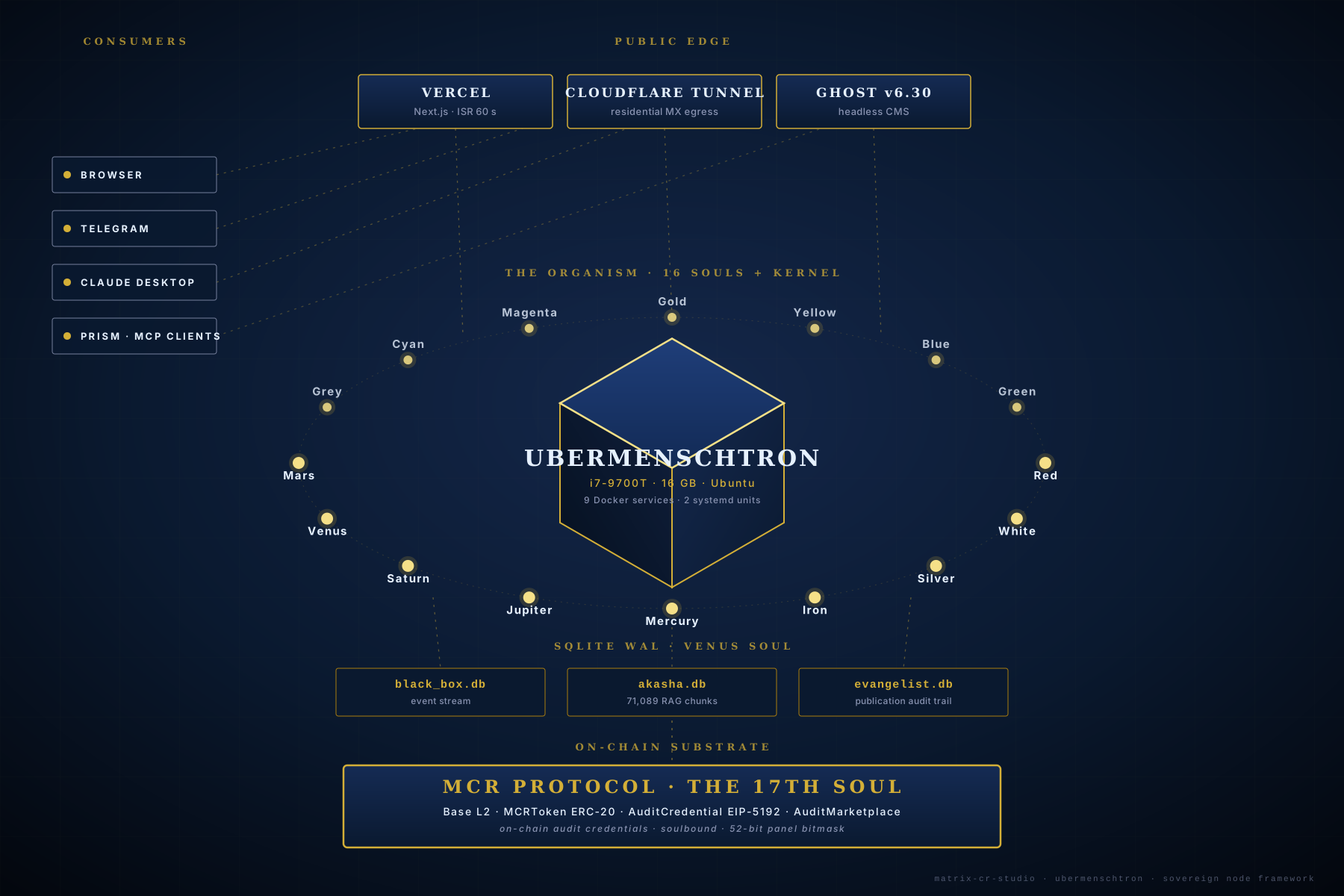
The Ghost CMS serving this very post runs in its own Docker container on the same box. No Vercel database. No Notion. No Contentful. The Next.js frontend at matrixcr.ai is statically generated on Vercel with 60-second ISR against Ghost — so the render is edge-cached globally, but the source of truth is the container three meters from my desk.
The LLM tiers
This is the piece that makes $0/mo true:
| Tier | Provider | Model | Used for | Cost shape |
|---|---|---|---|---|
| T1 | Anthropic | claude-sonnet-4-5 |
Gold synthesis, high-stakes reasoning, external comms | Metered — capped |
| T2 | Alibaba | Qwen (Plus / Max) | Construct panelists, Magenta creative | Low-cost, often free credits |
| T3 | Local Ollama | llama3.2:latest |
24 Construct personas, bulk drafts, fallback | Free (electricity only) |
| T4 | Free APIs | Groq / Together / Gemini | Experimental, spike handling | Free tier |
The routing happens in src/llm_router.py. A soul does not know or care which tier answers its request — the router picks based on a per-call budget, persona tier tag, and latency class. If T3 would OOM on a 16 GB host (we learned this the hard way trying to run qwen3:14b), the router falls through to T2 or T4.
What $0 does not include: the Anthropic API budget itself. That's metered. Our self-imposed cap is $40/month, and Gold alone eats most of it. But Anthropic spend is not infrastructure — it is content. If we cut it tomorrow, the swarm still runs; it just runs with duller synthesis.
What breaks
Three things break, predictably, on a sovereign 16 GB node. Pretending otherwise would be Cyfrin-impossible-demo territory.
1. Ollama OOMs on 14B-class models
We tried qwen3:14b in Ollama. It kept dying under the Docker swarm's concurrent load. Memory: we fit 16 GB RAM, 9 Docker services, and two systemd units on one box. The 14B model needs ~11 GB resident just for weights, and the Python swarm at idle is sitting around 3 GB. That leaves zero headroom for anything else — Ghost CMS alone wants 1.5 GB.
We moved to llama3.2:latest (3B parameters, ~2.2 GB resident). The quality gap is real — llama3.2 is not Claude Sonnet. We close it two ways: (a) Phase 3 AKASHA RAG injects primary-source passages into the prompt, so personas quote Aristotle or Aquinas verbatim instead of paraphrasing from training data, and (b) any persona producing output that leaves the studio (external comms, IP-grade doc, bounty submission) routes through T1 Claude for final synthesis.
This is the kind of constraint a 64 GB cloud VM lets you ignore. We cannot ignore it. It shapes the architecture.
2. The IP breach
On 2026-04-16, we discovered that the GitHub repository containing the entire PLEROMA source had been public since creation on 2026-03-10. Thirty-seven days of exposure. GitHub traffic data (which only retains 14 days) showed 3,145 clones by 945 unique visitors, with acceleration from 54/day to 808/day.
This is not a hypothetical threat-modeling exercise. The source code is in the wild. The LICENSE was switched to ALL RIGHTS RESERVED the day of discovery. Build 104 deployed Operation Watchtower within 24 hours — 83 zero-width Unicode watermarks across the codebase, 16 dead-code canaries, 7 honeypot credentials, dnstwist typosquat detection, crt.sh certificate transparency monitoring, Shodan infrastructure fingerprinting, PublicWWW deployed-code detection, and a weekly Construct ip_recon panel (ex-NSA TAO / ex-CIA targeter / ex-FBI white-collar / fed-circuit IP / KPMG forensic / Taleb antifragility).
The breach is why this post exists under ALL RIGHTS RESERVED instead of a permissive license. It is also why the next post in this series (our audit methodology) will be the last time we describe the 6-layer pipeline in this much detail publicly.
3. Architectural decoherence
The third thing that breaks is the graph itself. We ship fast. Every new soul or kernel module that isn't explicitly wired into every consumer that should import it becomes a dark organ — present in the body, unconnected to the nervous system.
src/cube.py scores this on a φ-weighted coherence index with floor φ⁻¹ = 0.618. Below that floor, the organism is DECOHERENT.
Yesterday's reading:
Capabilities: 161 (modules=93, souls=16, personas=52)
φ-coherence: 0.0000 (floor φ⁻¹=0.6180)
INTEGRATION GAPS: 1063  (🔴 High: 121  🟡 Medium: 53)
ORPHAN PERSONAS: 20
VERDICT: DECOHERENT
Zero. Not 0.3. Not 0.6. Zero. A thousand sixty-three gaps, a hundred-twenty-one of them high-priority, twenty personas floating unrouted. The MCR Protocol mint module (Build 105) has no edge to bounty_hunter, pipeline, bounty_verifier, recon, auditor, or vuln_db — all of which should be able to call it to mint on-chain audit credentials for findings they produce.
We are publishing this number. It is terrible. It is also the reason we build. The Living Entity Protocol (Build 107) exists precisely because we caught ourselves shipping Build 102's 52-persona Construct and never pow-wow'ing it into the rest of the body. The operator's words at the time: "we added the 52 a few days ago — why automatically did you not pow-wow? This is a living entity, we are not treating it like that." That comment became src/cube.py.
A healthy organism measured at zero is a bug. A healthy organism that publishes its zero is a trajectory.
What this costs (really)
The infrastructure layer is $0. The rest of the costs, in descending order:
- Anthropic API: ~$30-40/month, self-capped. Variable. Could be zero if we routed Gold through Qwen, but we lose synthesis quality.
- Electricity: ~$8/month at residential Mexican tariffs. The mini-PC idles at 18 W, peaks at 42 W under concurrent Ollama load.
- Domain: $14/year for
matrixcr.ai. Cloudflare on top is free. - Hardware amortization: $400 one-time ÷ 36 months ≈ $11/month.
- Cloudflare Tunnel: free.
- Vercel static hosting: free tier (next-cache revalidates against the Ghost container above).
- GitHub private repo: free (post-breach, obviously).
Total recurring, at cap: ~$60/month. Most of which is Anthropic, which is content, not infrastructure.
The things we do not pay for that every "modern" AI studio does:
- AWS / GCP / Azure: $0
- Vercel Pro / Netlify / Railway: $0
- Pinecone / Weaviate / Qdrant Cloud: $0 (we use SQLite WAL + sentence-transformers)
- Datadog / Sentry / PostHog: $0 (Saturn + Grey + Venus do this in-band)
- OpenAI: $0 (deliberate — sovereignty tier rules exclude it)
- Notion / Linear / Slack enterprise: $0
Somebody out there is paying $3,000/month for the same functional surface we run for the price of two cortados.
Post-quantum by default, not retrofit
This is the non-negotiable architectural decision. Every inter-soul IPC call is wrapped in the Parochet Protocol:
- ML-KEM-768 key encapsulation (NIST standardized, Kyber lineage, post-quantum secure at security level 3).
- AES-256-GCM for the symmetric payload.
- SHA3-512 for payload anchoring.
- SATOR HMAC — a palindromic time-windowed HMAC-SHA256 over a 30-second window. Named for the palindrome
SATOR AREPO TENET OPERA ROTAS— the property we want is that sender and receiver, within the same 30-second slice, derive the identical HMAC regardless of clock-skew direction. Seesrc/ghost.py:166forgenerate_sator_hmac.
Every soul presents a SATOR HMAC before entering the kernel routing space. Invalid HMAC = immediate rejection. Valid HMAC = crossing the veil. This runs in production — not a feature flag, not a simulation mode — on every internal call.
The cost: roughly 400 µs per call on the i7-9700T, mostly spent in the HKDF derivation. At our current call volume (47 k pulses × ~3 inter-soul calls per pulse), the PQC overhead is ~56 seconds of CPU per day, or 0.06%.
Why this matters for the blog post after next: if you read serious post-quantum timeline analyses (Google's 2029 target, Cloudflare's 2029 target), the uncomfortable conclusion is that the gap between "we should migrate eventually" and "adversaries are already harvesting encrypted traffic for later decryption" is already closed. Post 3 in this series goes into the IBM Quantum hardware measurements that tighten the Q-Day bound further. Here, it is enough to note: if your AI infrastructure is not PQC today, your inter-service traffic from 2026 will be readable in 2029.
Why we publish the decoherence number
Most infrastructure blogs tell you what works. This is because most infrastructure blogs are written by people trying to sell you cloud services, enterprise support contracts, or hiring clicks. The things that break are either hidden in a "war story" genre post once a year or buried in a post-mortem deep enough to avoid the sales funnel.
We run a sovereign AI studio on 16 GB of RAM with a decoherence score of zero, twenty orphan personas, a thousand integration gaps, and a documented IP breach thirty-seven days old. We publish all of this because the reader who can only trust a bloodless pitch is not our reader. The reader we want is the one who read φ = 0.0000 above and thought: those are the people I want to talk to, because they will not lie to me when something actually matters.
That reader is, we suspect, also the one running infrastructure, trying to stop paying $3k/month for functionality they could own outright, and wondering whether the sovereignty tax is worth it.
The short answer is: it is worth it, and it is smaller than you've been told. One mini-PC, one person, 48 builds in 42 days, a 17-soul body that pulses on its own, and a living reflex (cube) that calls you a hypocrite when you ship organs the body doesn't know about yet.
The next post in this series is the audit methodology — 6 layers, DMAIC-mapped, with a working exploit against the Intuition Protocol's ProgressiveCurve contract that our framework caught and Slither did not. The post after that is the Q-Day timeline, anchored in two independent runs of an E8-root-lattice Quantum Phase Estimation circuit on ibm_fez. Both will be longer, more technical, and — if we're doing our job — more honest than what's currently in the market.
If you'd like to be notified when they publish, there's a Telegram channel in the footer. There is no email signup because we do not run a newsletter funnel. There is no "subscribe to unlock" because we are not unlocking anything. The posts are here. Read them or don't.
Architecture reference: matrixcr.ai/research · IP claims registry: internal, not publicly distributed post-breach · Hardware: Dell Optiplex 7070, Intel i7-9700T, 16 GB DDR4, Ubuntu Linux · Node: Ubermenschtron · Location: San José, Costa Rica.